Book Review: The Master and Margarita by Mikhail Bulgakov
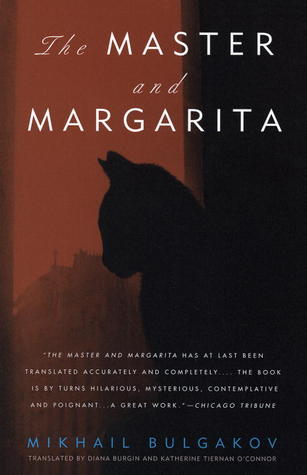
The Master and Margarita by Mikhail Bulgakov is the latest book selected for our Santiago Book Club. The Amazon blurb is quite brief: Set in Moscow of the 1920’s, this satirical novel recounts the dealings a writer and his mistress have with Satan.
Read on for my full review.
Overall Impression
This was a pretty interesting and fantastical novel. It had a lot of crazy elements in it, yet still manages to tell a good story. The Russian character names are a bit confusing, but most of them are secondary except for the Devil and company. The plot goes back and forth between events in Moscow and the novel the master is writing (about Pontius Pilate and Jesus aka Ha-Nozri). While they do connect in the end, it still feels a bit forced. There are plenty of footnotes in my version and it was good to read them to get the backstory on some of the qualities of Russian life in the 1930s.
Plot
The story generally follows ordinary characters in Moscow as their lives intersect those of the Devil, his lackeys, or other people affected by them. All sorts of crazy things start happening, with people dying, undying, going insane, singing in a loop, flying naked, and such. It’s very interesting to see how characters try to fight back and try to outsmart the Devil. Lots of great, fantastical stuff happens.
At the same time, there is a re-telling of the story of Jesus in the moments before and after the crucifixion. This is told either through memories (ie, the Devil’s) or through a book. The symmetry behind this plot line and the main one is a bit disconnected, though. Only at the very end do we see the connections.
Characters
There are many characters in the story, though most of them have long, Russian names that are quickly forgotten. It’s actually a bit hard to tell who is the main character as so much of the story is taken up by the Devil and his assistants. These come off as the bad guys, but are certainly having a lot of fun in Moscow. You have Professor Woland (the Devil himself), Behemoth, Koroviev, Azazello, and Hella. Each one individually is quite interesting and fully capable of completely messing up their intended targets with all manner of mischief.
Perhaps the main characters are intended to be the master and Margarita herself. However, these are introduced fairly late in the story; about halfway for the master and maybe 2/3 or 3/4 in for Margarita. As such, they feel far less developed and we, as readers, are less interested in their stories compared to what the Devil is up to.
Setting / World Building
The story is set in Russia around the 1930s. There are plenty of references to the local culture or way of life. In fact, there are footnotes that frequently clarify some aspect of this. Despite this, it feels less ‘Russian’ when I compare it to The Winds of Khalakovo by Bradley P. Beaulieu. I think, though, that it’s because this book is more casual whereas The Winds of Khalakovo takes itself more seriously and relies too much on stereotypes to transform a fantasy setting into something like Russia.
The Master and Margarita features the Devil and his retinue of strange helpers. They have great powers and generally wreak havoc all over Moscow. I was reminded at times of the anime Mythical Detective Loki Ragnarok as it features a god (Loki) and his children (Fenrir, Hel, etc) in the real world getting into (and out of) trouble. Having the Devil running around with his ‘unclean powers’ makes The Master and Margarita feel more fantastical, which is always a plus in my book. I do feel like there may have been a few inconsistencies in the magic system, but it could also be that we never get a clear picture of exactly what the Devil and his lackeys can do and why they’re there to begin with.
Final Thoughts
This book was better than I expected. Although I wouldn’t call it a favorite, I can see why some people really like it. By itself, it’s a good fantastical tale set in more modern times (compared to say, medieval Europe). It’s a bit over the top at times, but still enjoyable.