Book Review: Radiant Star by Ann Leckie
Book review for Radiant Star by Ann Leckie
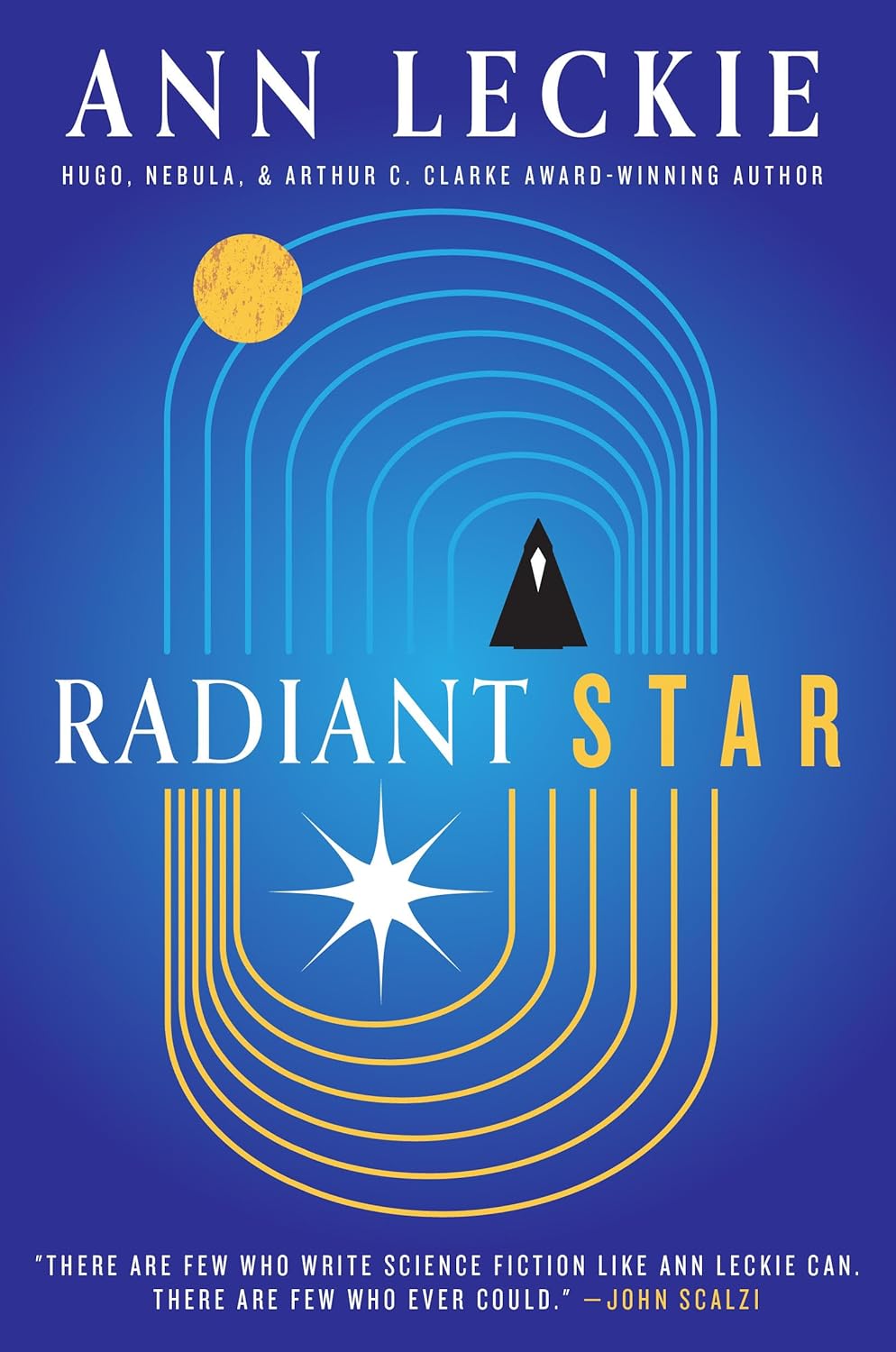
I’m a fan of Ann Leckie’s work and while this isn’t a continuation of the plot of Ancillary Justice, it is still set in the same universe centered around other people impacted by the ramifications of that trilogy.
Here is the official blurb for Radiant Star:
Space opera’s sharpest mind returns to the world of the Imperial Radch in this brilliant standalone from award-winning author Ann Leckie.
The Temporal Location of the Radiant Star has always been a source of both conflict and hope for the people of Ooioiaa. However, the imperial Radch see it only as an inconvenience, an antiquated religious site soon to be absorbed into their own, superior culture. But local politics is complicated, and the Radch have made a final concession: One last man will be allowed to join the mummified bodies in the temporal location to become a “living saint”.
But this decision will ripple out to affect every part of the city. Amidst a slowly worsening food shortage, riots, and a communication blackout from the rest of the Radch Empire, a religious savant will entertain visions of his own sainthood, a socialite will discover hir comfortable life upended, and a young man sold into servitude will find unlikely escape.
Read on for my spoiler-free review.
Overall Impression
This is an interesting, isolated story set in the universe of the Imperial Radch. There is a lot of exposition, which may detract from the plot for some readers. The characters and setting were pretty interesting and while it doesn’t expand much on the greater story, it was still enjoyable to read.
Plot
This is probably one of the slower books in this universe, not because the plot is slow, but because there is a lot of exposition and world building. The story is told in the form of a third-person omniscient narrator who will frequently take seeming tangents to discuss aspects of the world of Aaa, its people, and its religion. It’s very interesting if you’re that type of reader, but it does mean there is more telling than showing. The characters do take actions, but they seem almost secondary in this novel.
In terms of the narrative, it focuses on the city of Ooioiaa, recently conquered by the Radch Empire. It is well known for pilgrimages to a unique religious site- the Temporal Location of the Radiant Star. But when the conflicts described in Ancillary Justice take place, it finds itself increasingly isolated and tensions between the citizens start mounting.
Characters
There are several prominent characters in the book, and lots of secondary ones. We have Jonr, a young man of the Consorority of the Translocation; Serque Tais, a rich entrepreneur with a complex relationship with his family; Savant Keemat, of the Temporal Location of the Radiant Star; and many more. Greed is a central theme in this book- a lot of characters are driven by it. I was reminded about how often science fiction can be a reflection of the times. This is one such case, just like Children of Strife, which I finished recently.
As before, Leckie plays with many neo-pronouns to denote the gender of the characters. The Radchaii ones all use she/her, but others in the story use he/him, she/her, they/them, sie/hir, and per/per. The last one threw me off since per is a preposition in English and here it’s used as a pronoun. There was a neat scene with 3 characters, one he, one sie, one they, and this helped keep the conversation very clear. I think at this point we have seen he/she/sie/e/per/ve/ze/xie across Leckie’s books and it’s clear the difference between them isn’t important when it comes to character development.
Setting / World Building
The setting is very interesting in this book. The planet Aaa is a rogue planet, which means it was ejected from a solar system and has no star. It is always night and the city of Ooioiaa is built underground. I also like the pseudo-religious trappings of the “Site of the Temporal Location of the Radiant Star” and the Consorority of the Translocation. The mysticism behind all of that makes it unclear if it’s real or not, a sharp contrast to the more direct, if bizarre, nature of Translation State.
A minor criticism is that there are some words that are heavily overused, perhaps to give a sense of the culture or future aspects of the setting. The main one here is “extruded”, which is used as an adjective for nearly everything. I have no problem with it in the setting, just the overuse of an unfamiliar word can be distracting to readers (see for example puissant in The Scar).
There are also some interesting aspects that remind me of Dune, by Frank Herbert. The third-person omniscient narrator is one, as is the religious mysticism. But the one that really drives it home is some of the focus on the ecology of the planet. For example, the water purification system of the city of Ooioiaa gets a lot of attention.
Final Thoughts
Overall, this was a pretty good book. I’m perfectly fine with heavy exposition if the setting is interesting, but can imagine this can put off some readers. I was cheering for the good guys in the story and hoping they would come out all right. I do hope we revisit the main plotline of the Imperial Radch to see how it resolves, but regardless I’m enjoying these excursions into other worlds in this universe.